

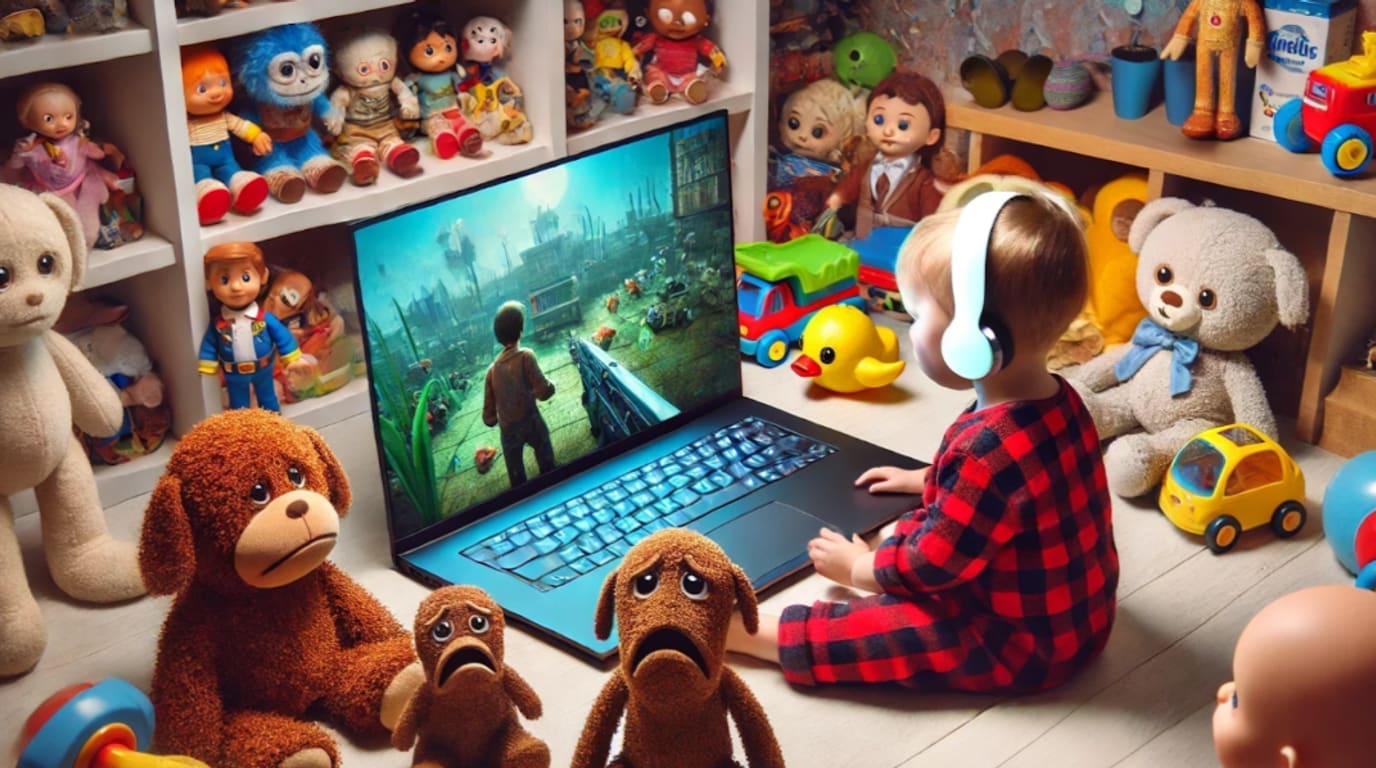
For most toddlers, screens are part of everyday life. We increasingly see a toddler calmly watching or using a smart device on public transport or during a meal. Perhaps we have used this ourselves to distract a toddler. Are we really living in a world of digital toddlers?
According to data from the latest research in the United Kingdom (2024), only 16% of 3-4 year-olds have never used the internet. Among those who have, most have access to a tablet (67%) and a smartphone (43%). 23% of toddlers use this access to play video games. At this age, social media use also appears (10% Facebook, 9% Instagram, 12% TikTok), although these are only permitted for those over 13 years old.
Research in Portugal (2022) reports that preschool children (3-6 years) most frequently find themselves in front of a television (95.1%), followed by a smartphone (66.2%) and a tablet (66.2%). Approximately one in five has their own smartphone, whereas in the United Kingdom, one in four 3-4 year-olds already has one.
Mateja Rek also studied screen use between 2015 and 2022 in a Slovenian sample and observed that among preschool children, parental restriction of use is not decreasing. According to data from 2022, on average, 1-3 year-olds are exposed to television for 26 minutes daily, and to tablets and phones combined for around 15 minutes, which doubles by ages 4-6.
What are these figures like around the world?
Five-year-olds in Finland (2021) use devices for 114 minutes daily, in Belgium (2018) for 81 minutes, in the USA (2017) for 159 minutes, and in Portugal, preschool children (3-6 years) spend mostly 1-2 hours per day in front of screens, and more than two hours mostly over the weekend.
This is twice the recommended daily amount for a five-year-old. The recommendation of Slovenian paediatricians is that screen exposure should not begin before a child's second year, and from the second to fifth year (with gradual introduction of screens), exposure should be limited to a maximum of 1 hour. Guidelines for screen use can be found in the link.
Why? What are the consequences of screen use for a child's development?
Excessive screen use can have far-reaching consequences for a child's development. Observations of some educators in Portuguese kindergartens are that children find it more difficult to explore materials and toys, jump more quickly from one activity to another, and play in a less creative and more aggressive way. All this, as well as language development problems (articulation and speech) that they observe, is also attributed to increased use of digital technologies.
What do the studies say?
→ Impact on social development: Screen use reduces the quantity and quality of interactions between children and their carers, which can negatively affect language development. Researchers suggest that this often happens because activities in front of screens replace play and reading. Even television being on in the background negatively affects child play and parent-child interactions. Use before the second year has also been shown to be harmful to facial expression and gesturing abilities. Contextual elements, such as joint viewing, explanation of what is happening, and topic appropriateness, are key in determining how screen use affects language development. If a child passively uses screens, this can hinder their ability to understand emotions, encourage aggressive behaviour, and damage overall mental health. However, if a child watches appropriate digital content together with an older person, especially content that invites the child to interact and encourages participation, then screens can in some ways have positive effects on language development.
→ Impact on cognitive development: Researchers observe a negative impact on cognitive inhibition – in neuroscience studies, this effect was particularly noticeable in children aged 14 months to 9 years. Children aged 3.5 to 5 years showed reduced cognitive flexibility, with negative effects observed with just 15 minutes of daily screen use. A negative impact on attention was detected with as little as one hour of daily screen use, with harmful effects observed in children aged 2-5 years and 9 years. Immediate negative effects were more pronounced in older children (5-7 years), while in younger children (14 months to 3.5 years), effects were observed to be medium to long-term.
→ Impact on physical development: Excessive screen use weakens the development of gross motor skills and is associated with obesity, reduced physical activity, and other health problems. Passive screen use, such as watching television without interaction, can lead to more sedentary time and less engagement, which negatively affects development.
How should I act as a parent? What are appropriate contents for my child?
The family environment itself has proven to be the most important factor in problematic screen use among children, so parents have a key role here. Parents can manage screen use in children by setting limits and setting a good example.
Yang and colleagues (2024) found that the context of screen use significantly affects a child's cognitive development, not just screen time itself. According to Slovenian paediatricians' recommendations, children from age two to five should always use screens in the company of parents and should not be exposed to digital advertising. Puzio and colleagues (2022) find that high-quality, age-appropriate children's programmes can be recognised by the following characteristics:
- they are interactive and engaging,
- they have educational value,
- they offer developmentally appropriate content,
- they contain positive and prosocial messages,
- they contain minimal fast-paced or violent content.
You can find sources of quality content in Slovenian through the link on the medical chamber's website.
Below we have compiled some basic screen handling guidelines for parents of preschool children.
:)
- We use screens with toddlers together.
- We check the content that toddlers watch and talk about it with them.
- We encourage shared reading, play, physical activity, and other alternative activities.
:(
- We do not use screens as rewards, comfort, or substitutes for supervision. This can harm emotional development and self-regulation in preschool children.
- We do not leave screens on in the background.
- We do not allow screen use beyond the recommended daily time.
Sources
Chakranon, P., Huang, J.-P., Au, H.-K., Lin, C.-L., Chen, Y.-Y., Mao, S.-P., Lin, W.-Y., Zou, M.-L., Estinfort, W., & Chen, Y.-H. (2024). Behavioral impact of early smart device usage on toddlers: Importance of mother–child interaction. Research Square. https://doi.org/10.21203/rs.3.rs-3982009/v1
Cheng, L., & Cao, J. (2023). Factors influencing smart device addiction among preschool children: An extended protection-risk model perspective. Frontiers in Psychology, 14. https://doi.org/10.3389/fpsyg.2023.1017772
Cucalón-Benito, N., Pérez-Palao, L., & Fernández-Valero, R. (2023). Impact of abusive screen use on childhood neurodevelopment: Systematic review. Medical Research Archives, 11(3). https://doi.org/10.18103/mra.v11i3.4730
Li, M., Zhao, R., Dang, X., Xu, X., Chen, R., Chen, Y., Zhang, Y., Zhao, Z., & Wu, D. (2024). Causal relationships between screen use, reading, and brain development in early adolescents. Advanced Science. https://doi.org/10.1002/advs.202307540
Liu, L. (2022). The impact of screen time on working memory function of children and adolescents. 2022 International Conference on Sport Science, Education and Social Development. Atlantis Press. https://doi.org/10.2991/assesd-22.2022.39
Monteiro, R., Fernandes, S., & Rocha, N. (2022). What do preschool teachers and parents think about the influence of screen-time exposure on children's development? Challenges and opportunities. Education Sciences, 12(1), 52.
Muppalla, S. K., Vuppalapati, S., Pulliahgaru, A. R., & Sreenivasulu, H. (2023). Effects of excessive screen time on child development: An updated review and strategies for management. Cureus. https://doi.org/10.7759/cureus.10353947
Niiranen, J., Kiviruusu, O., Vornanen, R., Saarenpää-Heikkilä, O., & Paavonen, E. J. (2021). High-dose electronic media use in five-year-olds and its association with their psychosocial symptoms: A cohort study. BMJ Open, 11(3), e040848. https://doi.org/10.1136/bmjopen-2020-040848
Ofcom. (2024, April 19). Children and parents: Media use and attitudes report 2024. Ofcom. Retrieved from https://www.ofcom.org.uk/media-use-and-attitudes/media-habits-children/children-and-parents-media-use-and-attitudes-report-2024/
Puzio, D., Makowska, I., & Rymarczyk, K. (2022). Raising the child—Do screen media help or hinder? The quality over quantity hypothesis. International Journal of Environmental Research and Public Health, 19(16), 9880. https://doi.org/10.3390/ijerph19169880
Rega, V., Gioia, F., & Boursier, V. (2023). Problematic media use among children up to the age of 10: A systematic literature review. International Journal of Environmental Research and Public Health, 20(10), 5854. https://doi.org/10.3390/ijerph20105854
Rek, M. (2019). Media education in Slovene preschools: A review of four studies. CEPS Journal, 9(1), 45-60.
Xie, H., Liu, C., Wang, S., & Wang, X. (2024). Screen time and preschoolers' pre-academic and behavioural competence: The moderating role of child characteristics. Early Child Development and Care. https://doi.org/10.1080/03004430.2024.2303473
Yang, S., Poncet, L., Tafflet, M., Lioret, S., Peyre, H., Ramus, F., Heude, B., & Bernard, J. Y. (2024). Association of screen use trajectories from early childhood with cognitive development in late childhood: The EDEN mother–child cohort. Computers in Human Behavior, 152, 108042. https://doi.org/10.1016/j.chb.2023.108042
Yang, S., Saïd, M., Peyre, H., Ramus, F., Taine, M., Law, E. C., Dufourg, M.-N., Heude, B., Charles, M.-A., & Bernard, J. Y. (2024). Associations of screen use with cognitive development in early childhood: The ELFE birth cohort. Journal of Child Psychology and Psychiatry. https://doi.org/10.1111/jcpp.13887